Franchise - 2026 FDD
Subway franchise
Subway restaurants offer foot-long and other sandwiches, salads, and other food items. A Subway franchisee operates a retail establishment that prepares and sells these items. The franchisor focuses on establishing all restaurants as franchises, sometimes owning or operating locations temporarily until a new franchisee is found.
Independent Franchise.com profile
Subway 2026 Franchise Disclosure Document, issued April 30, 2026. Existing outlets and disclosed development do not establish current market availability.
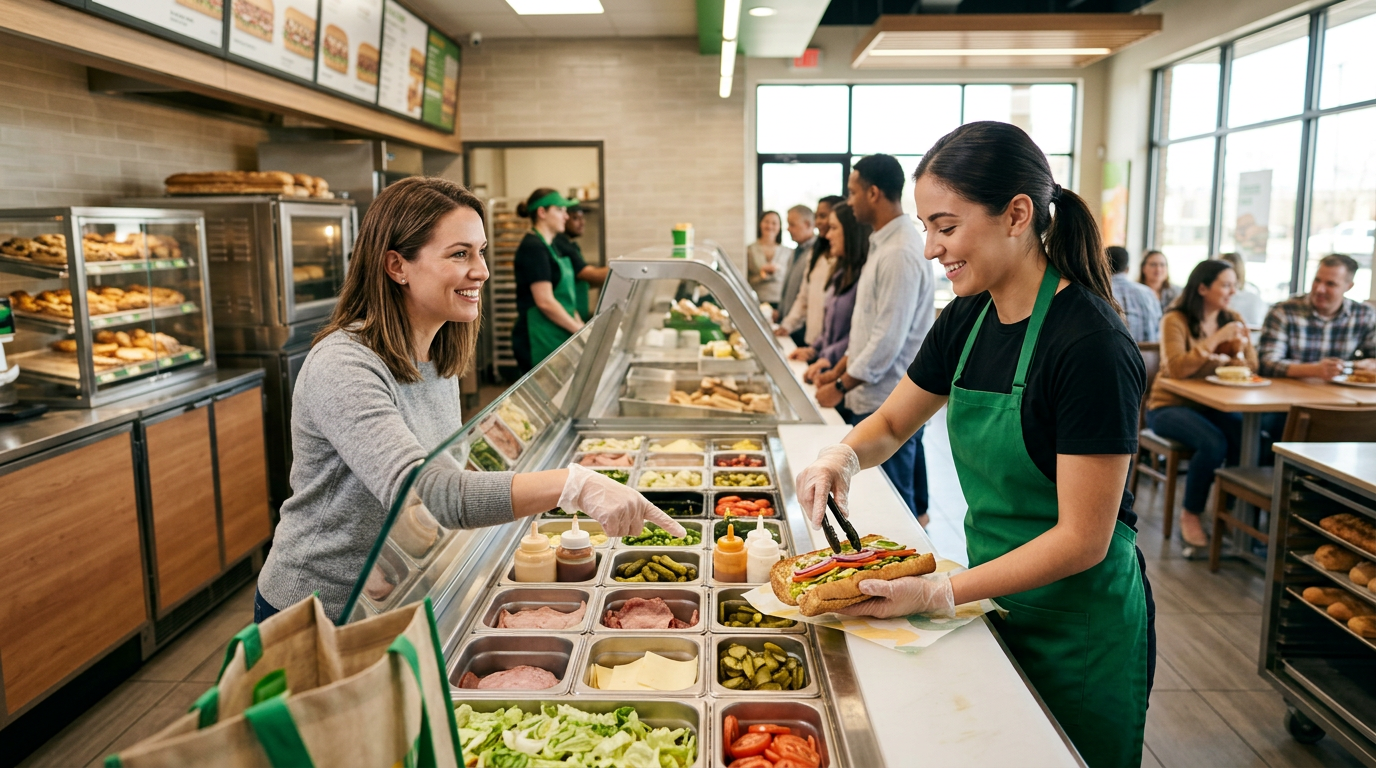
Subway restaurants offer foot-long and other sandwiches, salads, and other food items.
Getting started
Standard Location
Item 7 stated investment$263,000-$630,000
Initial franchise fee$15,000
Typical time to open2-12 months
Recommended prototypeApproximately 1,375 square feet, ranging from 300 to 2,000 square feet, in strip centers, enclosed malls, food courts, free-standing buildings, downtown locations, and seasonal and non-traditional sites.
Ownership & operation
What the local business requires
Day-to-day operatorOwner or a trained and competent full-time manager
On-premises during peak hoursRequired, at all times
Key required roleFull-time manager
Owner performs the service personallyNot required; owner or a trained manager must supervise
System size
U.S. - year-end 2025
total units18,773
Franchised Restaurants (latest disclosed FY)18,773
Franchised-unit change across the disclosed window-1360 (-6.8%)
FPR categories disclosedNo
System Size and Recent Changes
How large is the Subway system, and how has it changed?
Subway ended its latest fiscal year (2025) with 18,773 franchised outlets and no company-owned outlets. From 2023 to 2025, the number of franchised outlets decreased.
2023
20,133
franchised outlets
2024
19,502
franchised outlets
2025
18,773
franchised outlets
Card: net change note: The total number of franchised outlets decreased by 1360 (-6.8%) from year-end 2023 to year-end 2025.
Card: openings/reductions note (latest disclosed FY): In 2025, 499 franchised outlets opened. Reductions included 4 terminated, 46 not renewed, 148 reacquired by the franchisor, and 1,026 ceased operations for other reasons.
See development context, year-end system size and 2025 franchised outlet movement
Development context: As of year-end 2025, 93 franchise agreements had been signed for outlets not yet open. The franchisor projects 100 new franchised outlets in the next fiscal year; these figures do not establish current market availability.
Year-end system size
| Year | Franchised outlets | Company-owned outlets | Total outlets |
|---|---|---|---|
| 2023 | 20,133 | 0 | 20,133 |
| 2024 | 19,502 | 0 | 19,502 |
| 2025 | 18,773 | 0 | 18,773 |
2025 franchised outlet movement
| Measure | Count |
|---|---|
| Franchised outlets at start of 2025 | 19,502 |
| Opened | 499 |
| Terminated | 4 |
| Not renewed | 46 |
| Reacquired by franchisor | 148 |
| Ceased operations - other | 1,026 |
| Franchised outlets at end of 2025 | 18,773 |
| Transfers to new owners | 1,307 |
All profile counts use the FDD's outlet terminology. Existing outlets, signed development and projections do not establish current territory availability.
More options
Compare this system with others
Look at more franchise opportunities and how their size, fees, and investment compare.
Startup costs
How much does a Subway franchise cost?
The total estimated initial investment for a single Subway restaurant ranges from $263,000 to $630,000. Key cost drivers include leasehold improvements, estimated at $75,000 to $250,000, and equipment, furniture, and décor, ranging from $110,000 to $210,000. The standard initial franchise fee is $15,000, though discounts may apply for qualified U.S. Veterans or specific location types.
Where the money goes
$75,000-$250,000Leasehold Improvements
$110,000-$210,000Equipment, Furniture and Décor
$15,000-$45,000 for 3 monthsAdditional Funds - 3 months
$2,500-$4,500Grand Opening Advertising
Real-estate intensity callout: Real estate costs vary widely, with typical monthly rent ranging from $1,000 to $6,000. Restaurants typically measure approximately 1,375 square feet, though sizes can range from 300 to 2,000 square feet. The 'Fresh Forward 2.0' décor is required for all new restaurants and relocations, potentially increasing build-out costs, especially for freestanding locations with drive-thrus.
Launch Planning
- Typical opening timeline
- The typical length of time between signing the Franchise Agreement, location approval, and business opening is 2 to 12 months. This timeline is affected by factors such as site acquisition, obtaining leases, financing, building permits, zoning, weather conditions, shortages, equipment delivery, and installation.
- Site and lease milestones
- Franchisees are responsible for finding a location, which requires approval from the franchisor. Site evaluation considers potential guest base, traffic patterns, population density, visibility, and parking. If the franchisee does not own or directly lease an approved site, a leasing affiliate assists with lease negotiation. For satellite locations, proximity to a supporting Base Restaurant is a key consideration.
- Additional Funds
- Additional funds of $15,000 to $45,000 are estimated to cover initial start-up expenses for 3 months, including payroll costs. This estimate does not include royalty fees, advertising fees, food costs, or any allowance for an owner's draw.
- Grand-opening marketing
- A grand opening sale is required within 4 to 8 weeks after opening a new restaurant or a change in ownership. The franchisor recommends spending at least $2,000 on this grand opening sale.
- Fee commencement
- Royalty and advertising fees are payable weekly, due on or before the Friday following the close of the business week. Restaurant Technology Fees are payable monthly. Adyen payment processing fees vary depending on when a guest pays. Ingenico payment terminal fees also vary depending on when a guest pays. Subway Gift Card fees are paid to SVS as directed. Sub Club Program fees are payable weekly. POS System Hardware-as-a-Service Fees are due when the franchisee signs up. Digital Menu Board Hardware-as-a-Service Fee is payable monthly. Kount Fraud Protection Fee is billed monthly. Restaurant Design Charges vary. ServSafe Certification is due when applying for and/or renewing certification. Training fees are payable at the time of training registration, if applicable. Catering commissions are payable weekly when a guest places an order. Restaurant Excellence Visits Revisit Fees are due when incurred. Legacy Support Fees are assessed monthly.
See the full Item 7 cost table
| Type of expenditure | Low | High | When due |
|---|---|---|---|
| Initial Franchise Fee (1) | $15,000 | $15,000 | When you sign Franchise Agreement |
| Real Property (2) | $3,000 | $12,000 | When you sign Intent to Sublease or Sublicense, or direct lease |
| Leasehold Improvements (3) | $75,000 | $250,000 | Pro rata during construction |
| Equipment, Furniture and Décor (4) | $110,000 | $210,000 | When you place order |
| Optional Security System (not including monitoring) | $2,500 | $4,000 | When you place order |
| Freight Charges (varies by location) | $8,000 | $15,000 | Prepaid when you order or on delivery |
| Exterior Signage (10) | $5,000 | $12,000 | Divided: When you place order and upon install |
| Opening Inventory | $7,500 | $15,000 | Before opening |
| Insurance (5) | $1,500 | $7,500 | Before the equipment order can be placed |
| Supplies & Smallwares | $5,000 | $9,000 | Before opening |
| Training Expenses (6) | $4,500 | $6,500 | During training |
| Legal and Accounting | $1,000 | $6,000 | Before opening |
| Grand Opening Advertising (9) (10) | $2,500 | $4,500 | Around initial opening or after relocation, remodel, and/or transfer to a new franchisee |
| Miscellaneous Expenses (7) | $8,000 | $20,000 | As required |
| Additional Funds - (8) | $15,000 | $45,000 | As required |
| Item 7 table — stated total | $263,000 | $630,000 |
All figures in this Item 7 are estimates only, and actual costs will vary for each franchisee and location. The total represents the complete investment for setting up a Subway restaurant and operating it for three months. Costs could be substantially lower for non-traditional, satellite, or school lunch locations, or if the restaurant requires fewer leasehold improvements, less seating, and fewer equipment purchases.
Find your fit
See which franchises match you
A short quiz compares your budget, timeline, and goals with franchise opportunities. It takes about two minutes.
Ongoing fees
What ongoing fees does Subway charge?
Subway franchisees pay a weekly royalty fee and an advertising fee, both calculated as a percentage of gross sales. There are also various recurring technology and operational fees, some of which are fixed monthly charges. Additional fees may apply for specific programs, services, or if certain conditions are not met.
Royalty8% of total gross sales; may be reduced to 6.5%-8% for non-traditional locations (Airport Terminal, Train Station, Captive Travel Plaza) or 7.5%-8% for certain multi-unit franchisees
Total sales-based fees12.5%
Fixed technology and licensing fee$75 per month
Fixed monthly recurring total$1,304.30-$6,322 (Location Rent/License Fee $1,000-$6,000/month + either P400 Payment Terminal Software Fee $2.30/month or Ingenico Payment Terminal Monthly Lease Charge $10/month or Ingenico Payment Terminal Switching Fee $10/month + POS System Hardware-as-a-Service Fees $57/month + Digital Menu Board Hardware-as-a-Service Fee $155/month + Wireless Internet Router $15-$25/month + Guest-Facing WIFI $75/month)
| Economic category | Amount / basis | How it works |
|---|---|---|
| Audit fee | Royalty, advertising contributions, and other charges due on under-reported gross sales by more than 2% of reported sales, plus interest and late fees | If gross sales are under-reported by more than 2% of reported sales, the franchisee pays the royalty, advertising contributions, and other charges due on the under-reported sales, plus interest and late fees. |
| Brand fund | 4.5% of gross sales; may be reduced to 0.5%-2% for certain satellite, non-traditional, or school lunch locations, or 2%-3.5% for certain multi-unit franchisees | A fee of 4.5% of gross sales is paid weekly to an advertising fund, with certain locations or multi-unit franchisees eligible for reduced rates ranging from 0.5% to 3.5%. |
| Local advertising minimum | No ongoing minimum; 2.5% of gross sales is suggested for local advertising | There is no ongoing minimum required for local advertising, but setting aside an additional minimum of 2.5% of gross sales for local advertising is suggested. |
See secondary recurring and conditional charges
Marketing and technology
- Sub Club Program Fees
- A fee of 1.9% of gross sales applies to each transaction made by a Sub Club program member, subject to annual adjustments.
- Kount Fraud Protection Fee
- A fee of $0.0068 per digital transaction is charged for fraud protection services, subject to vendor price increases.
Training and operating obligations
- Restaurant Excellence Visits Revisit Fee
- A fee of $144.91 per revisit is charged if a restaurant receives a 'Fail' score during a Restaurant Excellence Visit, increasing by 3% annually starting January 1, 2027.
- Legacy Support Fee
- A monthly fee of $200 is assessed for noncompliance with technology standards, failure to return hardware, or unauthorized software installations.
Ownership, staffing and support
How is a Subway® business staffed and supported?
A Subway® restaurant must always be under direct, on-premises supervision by either the franchisee or a trained, competent employee acting as a full-time manager. Franchisees are strongly encouraged to devote substantial time to the business even if a manager is employed. The franchisor provides a comprehensive training program and ongoing operational support.
Ownership structure card
- A Subway® restaurant must be under the direct, on-premises supervision of the franchisee or a trained, competent full-time manager at all times.
- If the franchisee operates multiple locations or does not dedicate full-time effort, a Designated Manager is required for each restaurant.
- The business must remain open during hours specified in the Operations Manual, or other approved hours.
Local operating team card
- Franchisees are responsible for hiring all personnel and managing their work, training, compensation, and oversight.
- Restaurant employees must complete the Sandwich Artistry (North America) course and other designated training.
- The Designated Manager is not required to have an equity interest in the franchise entity.
Training and support card
- The New Franchisee Onboard Training Program is required for the franchisee or a Designated Manager before opening, totaling approximately 108 hours of web-based, facilitated, and on-the-job training.
- This program covers subjects such as restaurant management, guest experience, financials, and sales growth.
- Ongoing support includes consultations with a Business Developer and written materials on new developments.
Ownership signal callout: This franchise suits owners who are prepared to either personally manage the daily operations or oversee a dedicated, full-time manager. A hands-on approach is highly recommended, even when a manager is in place.
How customers find the business
How does a Subway business attract and retain customers?
Subway develops advertising programs and materials to promote the brand, building restaurant sales and profits, and promoting system identity. The brand also creates advertising materials for use by restaurant owners. Franchisees may face competition from other franchisees, company-owned outlets, or other distribution channels and competitive brands controlled by the franchisor.
What the system provides
- A national advertising fund (SFAFT) to which franchisees contribute 4.5% of gross sales.
- Development of advertising programs and materials to promote the Subway brand.
- A franchisee advisory board that consults on national advertising, marketing, and promotion.
- Access to the Subway intranet website, which is updated periodically.
- A required computer-based point-of-sale (POS) system with integrated software for sales reporting and business management.
- Training on various aspects of restaurant management, including guest experience and growing sales.
What the local operator executes
- Franchisees must contribute 4.5% of gross sales to the national advertising fund.
- An additional minimum of 2.5% of gross sales is recommended for local advertising, at the franchisee's discretion.
- All advertising materials developed by franchisees must be approved by the franchisor before distribution.
- Participation in all sales, marketing, advertising, and promotional programs implemented by the franchisor, using only designated or approved materials.
- Franchisees are required to operate only at the single approved location and do not receive an exclusive territory.
- Required participation in the Subway Remote Ordering Program, including maintaining POS and menus, and displaying signage.
The operating tension: While the franchisor provides significant advertising and brand support, the success of a location relies heavily on the franchisee's local marketing efforts, adherence to brand standards, and ability to convert customer interest into sales amidst potential competition from other Subway restaurants and affiliated brands.
Brand and agreement basics
Key Subway franchise agreement terms
Brand and ownership
- U.S. franchisor
- Doctor's Associates LLC
- Headquarters
- Shelton, Connecticut
- U.S. franchising history
- Since 1974
- Parent company
- Subway Funding LLC -> Subway Funding Holdco LLC -> Subway US Holdings, LLC -> Subway Worldwide System Holdings, LLC -> Underground Purchaser, LLC; acquired by Underground Purchaser, LLC on April 30, 2024
Agreement Terms
- Initial term
- 20 years
- Successor terms
- Renewal for an additional 20-year term is available if all material provisions of the Franchise Agreement are met and all monetary obligations are satisfied. A renewal fee of 25% of the then-current franchise fee is required.
- Territory
- No exclusive territory is granted. Franchisees may face competition from other franchisees, company-owned outlets, or other distribution channels.
- Multi-unit development
- Multi-unit development is offered to qualified purchasers through a Development Agreement, which may include a rebate of some or all of the initial franchise fee if development schedules are met.
Note: No financial performance representations are made. The franchisor does not make representations about a franchisee's future financial performance or the past financial performance of company-owned or franchised outlets.
More options
Keep exploring
If this brand is not the one, see more franchise opportunities that may fit better.
Frequently asked questions
Subway franchise FAQs
Does the owner have to personally perform the core service?
The provided information does not specify whether the owner must personally perform the core service. It describes the franchisee's role in operating a retail establishment that sells sandwiches, salads, and other food items.
Is the territory exclusive?
No, a Subway franchisee will not receive an exclusive territory. The franchisor and its affiliates retain unlimited rights to compete with franchisees and to license others to compete, including through other distribution methods like the Internet or call centers.
Can a franchisee develop more than one location?
Yes, if a prospective franchisee meets qualifications, the franchisor may approve them to operate multiple restaurants under a multi-unit development program. This program is governed by a Development Agreement and one or more Franchise Agreements or a Multi-Unit Franchise Agreement.
Can a prospective owner speak with current and former franchisees?
Yes, contact information for operating franchisees in the United States and its territories, as well as for franchisees who transferred or ceased operations in 2025, is available in Exhibits B and B-2. However, the franchisor has signed confidentiality clauses with some current or former franchisees, which may restrict them from speaking openly.
What is the initial investment required for a Subway franchise?
The initial investment for a single new Subway franchise ranges from $263,000 to $630,000, which includes $18,000 to $27,000 payable to the franchisor or its affiliate. For a non-traditional location, the range is $227,000 to $458,000.
How has the number of Subway franchised outlets changed recently?
The number of franchised Subway outlets decreased by 1360 (6.8%) from the end of 2023 to the end of 2025. In 2025 alone, 499 outlets opened, 4 were terminated, 46 were not renewed, 148 were reacquired by the franchisor, and 1026 ceased operations for other reasons.
Similar opportunities
Similar opportunities to Subway
Compare other franchises with Subway: Investment, Fees, Franchising history and system size at a glance.
Not able to find similar franchises.
Source and methodology
Source and methodology
Doctor's Associates LLC 2026 Franchise Disclosure Document, issued April 30, 2026.
This profile is based on information from the Franchise Disclosure Document, with automated tools assisting in the extraction and drafting of content, which was then reviewed and edited by a human editor.
Take the next step
Where are you in your decision?
Subway is not currently accepting inquiries through Franchise.com. Choose the path that matches how far along you are.
I like this type of business
Explore similar franchises
Browse these franchises on Franchise.com and compare investment, fees and system size side by side.
See similar franchisesI am not sure what fits me
Find your franchise match
Answer a few questions about your budget, goals and timeline, and see the franchises that best fit what you are looking for.
Take the match quizI am not sure I can afford it
Check your buying power
Use the Net Worth Calculator to see whether you have the resources to start a franchise at this investment level.
Calculate your net worth