Franchise - 2026 FDD
Taco Bell franchise
Taco Bell Express Units offer inexpensively priced, quality Mexican-style food for take-out eating. These units are situated at locations inappropriate for Traditional, In-Line, or End-Cap Units. The licensee must devote full-time personal attention to daily operations, or have an approved manager do so, and operates as an independent business person assuming all associated risks.
Independent Franchise.com profile
Taco Bell 2026 Franchise Disclosure Document, issued March 26, 2026. Existing outlets and disclosed development do not establish current market availability.
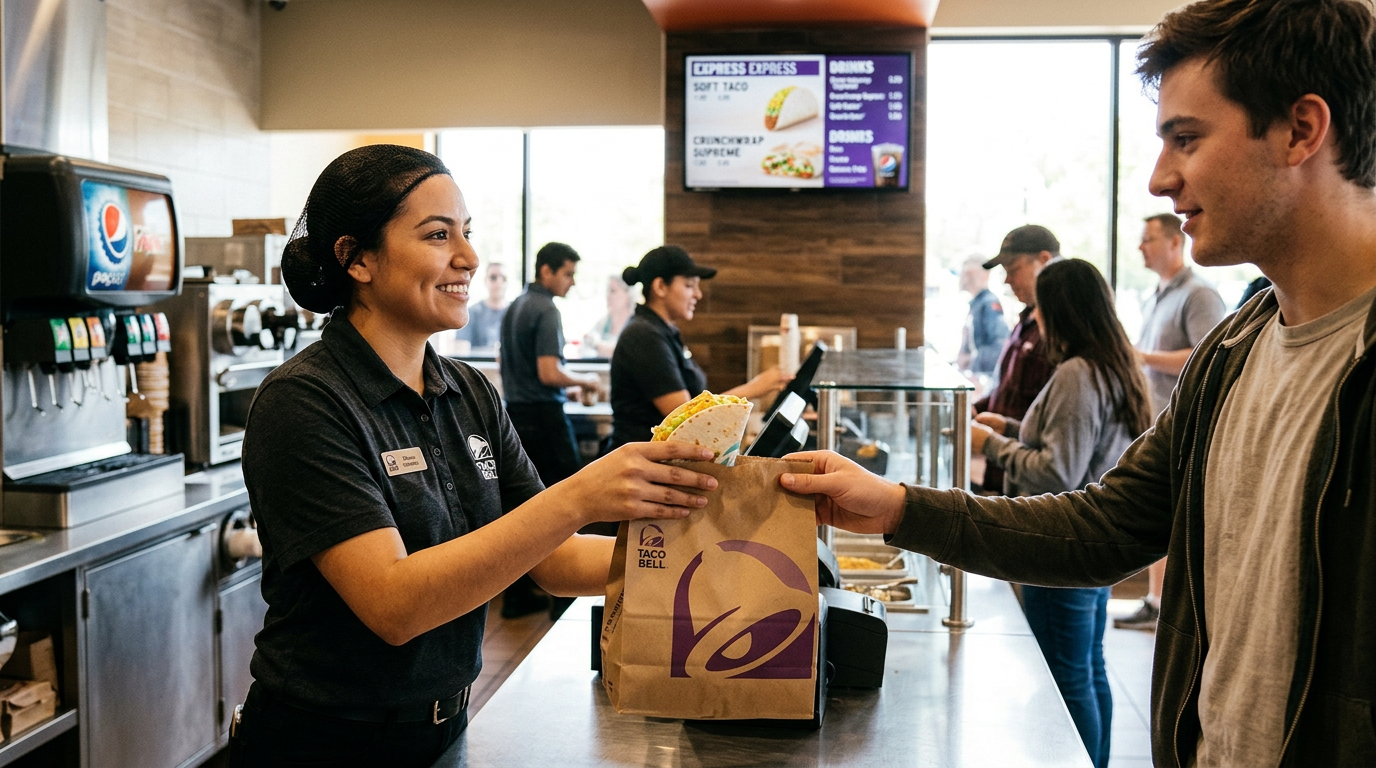
Taco Bell Express Units offer inexpensively priced, quality Mexican-style food for take-out eating.
Getting started
Standard Location
Item 7 stated investment$287,950-$857,700
Initial franchise fee$22,500
Typical time to open4 to 6 months
First Unit Construction Services$27,250
Ownership & operation
What the local business requires
Day-to-day operatorOwner or an authorized supervisor
On-premises during peak hoursNot specified; owner or a qualified restaurant manager must manage day to day
Key required roleTrained manager
Owner performs the service personallyNot specified; owner or a trained manager must manage full time
System size
U.S. - year-end 2025
total units235
Franchised Units (latest disclosed FY)221
Company-owned Units (latest disclosed FY)14
Franchised-unit change across the disclosed window-11 (-4.7%)
System Size and Recent Changes
How large is the Taco Bell system, and how has it changed?
Taco Bell Express had 221 franchised outlets and 14 company-owned outlets at the end of 2025. The number of franchised outlets decreased from 232 in 2023 to 221 in 2025.
2023
232
franchised outlets
2024
229
franchised outlets
2025
221
franchised outlets
Card: net change note: A net change of -11 franchised outlets, representing a -4.7% decrease, occurred from 2023 to 2025.
Card: openings/reductions note (latest disclosed FY): In 2025, 8 franchised outlets opened. During the same period, 5 units were terminated, 6 units were not renewed, and 1 unit ceased operations for other reasons.
See development context, year-end system size and 2025 franchised outlet movement
Development context: As of December 31, 2025, there were no license agreements signed for units not yet open. 9 new licensed units are projected to open in the next fiscal year. These projections do not establish current market availability.
Year-end system size
| Year | Franchised outlets | Company-owned outlets | Total outlets |
|---|---|---|---|
| 2023 | 232 | 7 | 239 |
| 2024 | 229 | 14 | 243 |
| 2025 | 221 | 14 | 235 |
2025 franchised outlet movement
| Measure | Count |
|---|---|
| Franchised outlets at start of 2025 | 224 |
| Opened | 8 |
| Terminated | 5 |
| Not renewed | 6 |
| Ceased operations - other | 1 |
| Franchised outlets at end of 2025 | 221 |
| Transfers to new owners | 5 |
All profile counts use the FDD's outlet terminology. Existing outlets, signed development and projections do not establish current territory availability.
More options
Compare this system with others
Look at more franchise opportunities and how their size, fees, and investment compare.
Startup costs
How much does a Taco Bell Express Unit license cost?
The total estimated initial investment for a Taco Bell Express Unit ranges from $287,950 to $857,700. The largest cost drivers include building/site construction, which can range from $50,000 to $300,000, and equipment/signage/decor/POS, estimated at $160,600 to $402,000. The initial license fee is a standard $22,500.
Where the money goes
$50,000-$300,000**Building/Site Construction (C)
$160,600-$402,000**Equipment/Signage/Decor/ POS
$10,000-$20,000 for 3 monthsAdditional Funds - 3 months
$2,250 for ADA inspection costsADA inspection costs for first unit
Real-estate intensity callout: The building and site construction cost estimates are based on development in Dallas, Texas. Actual costs vary considerably according to local building and zoning ordinances, prevailing construction costs, and the size and condition of the site. Express Units include stand-alone units within larger buildings and permanently constructed installations.
Launch Planning
- Typical opening timeline
- The estimated length of time between payment of the initial license fee deposit and the opening of the Unit is approximately 4 to 6 months. This timeline can be affected by factors such as obtaining governmental permits, weather conditions, labor difficulties, and delivery of signs and equipment.
- Contractual opening deadline
- If a Market Build Out Agreement is in place, and a Unit is not opened on time, a lump sum payment of $22,500 (or the balance if a $10,000 deposit was made) is due within 5 days of the missed deadline. Additionally, periodic payments of $4,231 will be due for each four or five-week accounting period until the unit opens or for 10 years, whichever occurs first.
- Site and lease milestones
- Each location is subject to the franchisor's market plan approval. The franchisor typically notifies of approval or disapproval of a site within 30 to 60 days of a complete site package submission. If a site is not approved, a License Agreement will not be issued.
- Additional Funds
- Additional Funds are estimated to be $10,000 - $20,000 and are meant to cover incremental operating expenses for the initial three months of business. These figures exclude finance charges, interest, or debt service payments, and also exclude costs associated with required training, including travel and living expenses for employees.
- Grand-opening marketing
- Licensees agree to advertise, market, promote, and merchandise the business. There is no obligation to expend a specified amount on advertising, except for required purchases of certain point-of-purchase materials. All advertising materials using the Trademarks must receive express written approval before use.
- Fee commencement
- The Period License Fee (royalty) of 10% of Gross Sales is due on or before the 5th business day immediately following the accounting period in which sales were made. Late charges are billed as incurred. The All Access Fee of $750/year and the Digital Transaction Fee of $0.19 per digital transaction are billed as incurred. The Gift Card Transaction Fee of $0.19 per transaction is billed as incurred.
See the full Item 7 cost table
| Type of expenditure | Low | High | When due |
|---|---|---|---|
| Background Check Fee | $500 | $700 | Upon application |
| Initial License Fee | $22,500 | $22,500 | $10,000 due upon site registration with balance due on groundbreak |
| First Unit Construction Services (B) | $27,250 | $27,250 | As provided in the Development Services Agreement |
| Optional Real Estate Services (B) | $10,000 | $37,250 | As provided in the Development Services Agreement |
| *Permits, Licenses, Security Deposits (D) | $500 | $10,000 | As incurred |
| Real Property - First month's rent | $2,100 | $4,500 | As incurred |
| Architectural Fees (D) | $1,500 | $25,000 | As incurred |
| **Building/Site Construction (C) | $50,000 | $300,000 | As agreed |
| **Equipment/Signage/Decor/ POS | $160,600 | $402,000 | As incurred |
| *Initial Inventory (E) | $3,000 | $8,500 | As incurred |
| *Additional Funds (3 months) (F) | $10,000 | $20,000 | As incurred |
| Item 7 table — stated total | $287,950 | $857,700 |
Certain security deposits may be refundable, but none of the other listed expenditures are refundable. The building and site construction cost estimates, along with those for architectural fees, are based on development in Dallas, Texas; actual costs will vary significantly by location due to local building codes, construction costs, and site conditions. Opening inventory figures are for the first week of operation, and actual costs will depend on sales performance.
Find your fit
See which franchises match you
A short quiz compares your budget, timeline, and goals with franchise opportunities. It takes about two minutes.
Ongoing fees
What ongoing fees does Taco Bell charge?
Taco Bell Express Units have a royalty rate of 10% of gross sales. There are also various recurring technology and support fees, including an annual All Access Fee and digital transaction fees. Additional fees may apply for specific services or in certain circumstances.
Royalty10% of Gross Sales
Total sales-based fees10% of Gross Sales
Fixed monthly recurring total$62.50-$1,854.17 (All Access Fee $750/year + Taco Bell IT Service Desk up to $6,000/year + Third-Party Vendor Technology Fees up to $15,500/year; annual fees ÷ 12)
Late chargesThe lesser of 18% per annum or the highest rate permitted by New York law, plus the then-customary administrative charge
| Economic category | Amount / basis | How it works |
|---|---|---|
| Audit fee | Cost of audit, if Gross Sales are understated by 2% or more | This fee is only due if an inspection of books finds an understatement of Gross Sales by 2% or more. |
| Local advertising minimum | No ongoing minimum | There is no obligation to expend a specified amount of funds on advertising, except for required point-of-purchase materials. |
See secondary recurring and conditional charges
Marketing and technology
- One-Step Merchandising Program
- A quarterly fee of $286 per restaurant provides national merchandising and menu support, with additional fees possible for extra marketing materials.
- Marketing, Advertising, Promotional and POP Materials
- Actual costs for marketing, advertising, promotional, and point-of-purchase materials are billed, including related taxes and administrative, shipping, handling, and storage charges.
Training and operating obligations
- Additional Trainee Fee
- The cost of the training program is included for the licensee and one restaurant manager, but a fee of $350 per person may be charged for any additional trainees or non-mandatory courses.
- Transfer Fee
- A transfer of interest in any Unit is subject to a transfer fee, with minimums ranging from $1,500 per unit to $7,500 per transfer for third-party transfers, and $2,500 for entity restructures.
Ownership, staffing and support
How is a Taco Bell Express business staffed and supported?
A Taco Bell Express business requires the owner's full-time attention or that of an authorized supervisor. Franchisees operate the business using a detailed system provided by the franchisor. Training and ongoing operational and technological support are provided to ensure compliance with brand standards.
Ownership structure card
- The owner must devote full-time attention and best efforts to the day-to-day operations.
- If an employee is authorized as supervisor, they must successfully complete training and also devote their full-time attention to daily operations.
- The owner or a qualified restaurant manager must reside within approximately one hour's driving time from the Unit.
Local operating team card
- Beyond the owner or authorized supervisor, the business requires a manager to successfully complete the initial training program.
- At least one manager per Unit must also obtain food safety certification.
- All restaurant employees are required to be certified in their specific job roles by completing e-learning courses and on-the-job requirements.
Training and support card
- Initial management training is a minimum of 7 weeks, potentially extending to 8 weeks, consisting of web-based, e-learning, on-the-job, and classroom training.
- This program, along with any other required ongoing training for new product roll-outs or system changes, is tuition-free for the owner and one restaurant manager.
- Additional people can be trained for a fee.
Ownership signal callout: This business model is suitable for hands-on owner-operators, or those who can appoint a dedicated, full-time, and trained supervisor to manage daily operations.
How customers find the business
How does a Taco Bell business attract and retain customers?
Taco Bell units benefit from the brand's established name and trademarks, offering quick-service Mexican-style food. Success is influenced by various factors including location, operator skill, and local competition. While the franchisor provides system standards, the independent business person assumes all associated business risk.
What the system provides
- Development and administration of advertising and sales promotion programs
- Establishment and maintenance of a marketing fund
- Pre-opening advice and site approval assistance
- Provision of an online platform (OneSource) with system standards and training courses
- National merchandising and menu support
- Access to specific technology, including POS, digital menu boards, and kiosks
What the local operator executes
- Required purchase of certain point of purchase materials
- Obligation to advertise, market, promote, and merchandise the business of the unit
- Obtaining express written approval for all advertising materials using the Trademarks
- No territorial protection, facing potential competition from other franchisees, company-owned units, and affiliated brands
The operating tension: The foodservice industry is highly competitive and sensitive to economic factors, requiring the operator's skill and acumen. While the franchisor provides support and a recognized brand, the owner is responsible for day-to-day operations and ultimately the unit's success, cash flow, and profitability.
Brand and agreement basics
Key Taco Bell franchise agreement terms
Brand and ownership
- U.S. franchisor
- Taco Bell Franchisor, LLC
- Headquarters
- Irvine, California
- U.S. franchising history
- Since May 11, 2016 (predecessor since 1964); franchised businesses operating since 1962
- Parent company
- Taco Bell Franchisor Holdings, LLC -> YUM! Brands, Inc.
Agreement Terms
- Initial term
- 10 years for new Express Units; 10 to 20 years for new Power Pumpers. Terms for existing KT Units range from 9 months to 5 years.
- Successor terms
- No renewal rights are granted, but a successor policy is in effect, subject to modification or cancellation. Successor agreements require operational and financial approval, unit upgrades, and a successor fee.
- Territory
- No exclusive territory or territorial protection is granted. The franchisor and its affiliates may establish other units or use trademarks anywhere, regardless of proximity to a licensed unit.
- Multi-unit development
- A Market Build Out Agreement may be required for the development of one or more new units, especially when purchasing existing units. This agreement specifies opening dates for new units.
Note: No financial performance representations are made regarding future or past financial performance of company-owned or licensed Express Units. The franchisor does not authorize employees or representatives to make such representations.
More options
Keep exploring
If this brand is not the one, see more franchise opportunities that may fit better.
Frequently asked questions
Taco Bell franchise FAQs
Does the owner have to personally perform the core service?
The information provided does not state whether the owner must personally perform the core service. It mentions that the skill and acumen of the restaurant's operator and staff are critically important.
Is the territory exclusive?
No, the license agreement does not provide territorial protection or exclusivity. The licensor and its affiliates reserve the right to establish additional units anywhere, including those that may compete with a licensee's unit, and may permit additional uses of the Trademarks without regard to proximity.
Can a franchisee develop more than one location?
If a licensee purchases existing units, they may be required to develop one or more new units according to a Market Build Out Agreement. This agreement specifies the dates by which new units must be open for business.
Can a prospective owner speak with current and former franchisees?
Yes, Exhibit F lists the name, address, and phone number of license units in operation, as well as every licensee who has had a unit terminated, canceled, not renewed, or otherwise voluntarily ceased to do business during the fiscal year ended December 30, 2025.
What is the initial investment required to open a Taco Bell Express Unit?
The initial investment to begin operation of a Taco Bell Express Unit ranges from $287,950 to $857,700. This includes $22,500 that must be paid to the licensor and, for the first unit only, $27,250 that must be paid to an affiliate.
What is the term length and royalty rate for a new Taco Bell Express Unit?
For new Express Units, the length of the term is 10 years, or 10 to 20 years for new Power Pumpers. The royalty rate is 10% of gross sales, and the initial license fee is $22,500.
Similar opportunities
Similar opportunities to Taco Bell
Compare other franchises with Taco Bell: Investment, Fees, Franchising history and system size at a glance.
Not able to find similar franchises.
Source and methodology
Source and methodology
Taco Bell Franchisor, LLC 2026 Franchise Disclosure Document, issued March 26, 2026.
This profile was compiled from the brand's Franchise Disclosure Document using structured information, with AI assistance for extraction and drafting, and was reviewed by a human editor for accuracy and completeness.
Take the next step
Where are you in your decision?
Taco Bell is not currently accepting inquiries through Franchise.com. Choose the path that matches how far along you are.
I like this type of business
Explore similar franchises
Browse these franchises on Franchise.com and compare investment, fees and system size side by side.
See similar franchisesI am not sure what fits me
Find your franchise match
Answer a few questions about your budget, goals and timeline, and see the franchises that best fit what you are looking for.
Take the match quizI am not sure I can afford it
Check your buying power
Use the Net Worth Calculator to see whether you have the resources to start a franchise at this investment level.
Calculate your net worth