Back to Blog
Education Franchise Profitability and Outlook

The structural demand case for education franchise profitability has been building for years, and in 2026, it is no different. Dual-income households are the norm across most demographic segments, women's workforce participation continues to climb, and parents are intentionally spending more intentionally on early childhood enrichment, tutoring, and youth fitness than any previous generation. That spending is not particularly sensitive to economic cycles.
When household budgets get squeezed, discretionary entertainment tends to get cut before structured childcare and education programming. That essential-needs quality is the foundation of why child services franchises are outperforming virtually every other sector in franchising right now.
Education Franchise Profitability and Outlook 2026
According to the IFA and FRANdata 2026 Franchising Economic Outlook, child services is the fastest-growing franchise sector by a wide margin, boosting education franchise profitability horizons. Establishments are projected to grow 4.3% to approximately 24,000 locations, output is forecast at $22.7 billion, and the sector is expected to account for 36.3% of all projected franchise employment growth across every category this year. In a year where QSR dominates unit counts and employs nearly 58% of the total franchise workforce, child services are responsible for more than a third of all new franchise jobs.
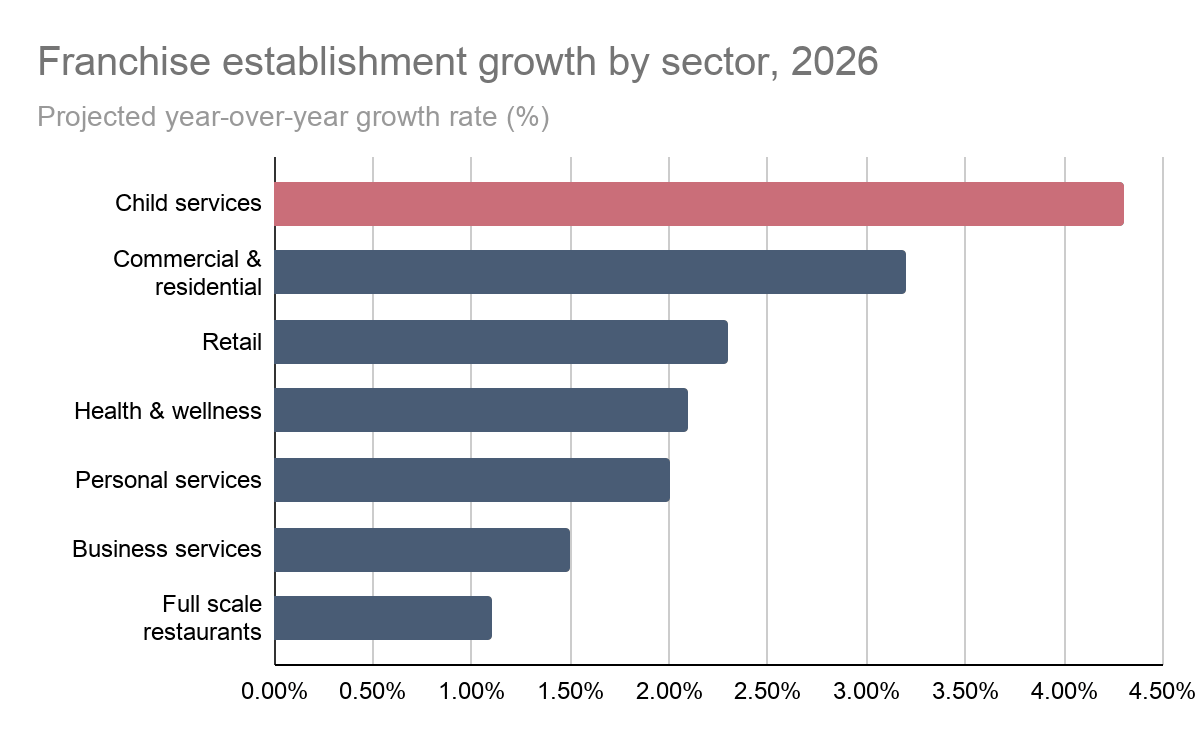
The report also flags youth fitness and sports as a high-conviction subcategory, projecting 53% growth by 2034, which is broadening the investment landscape well beyond traditional childcare and tutoring into enrichment concepts, indoor sports, and children's wellness programming.
Unit Economics
Education and child services franchises span a wide range of formats, from home-based tutoring and enrichment programs with relatively light overhead to brick-and-mortar childcare centers with higher capital requirements and substantially larger revenue potential. The benchmarks below reflect performance data across established franchised brands in the category.
Metric | Figure |
|---|---|
Average Unit Volume (AUV), 2024 | $350K - $750K |
Reported Net Margins | 15 - 22% |
Realistic Net Margins | 10 - 18% |
Average Franchise Income (Single Unit) | ~90K - $130K/year |
Franchisees Earning $150K | ~15 - 20% of operators |
Information is sourced from a 2026 FRANdata report or synthesized from the Franchise Disclosure Documents (FDDs) of education franchises.
The AUV varies widely across this category because the formats are genuinely different businesses. A mobile tutoring or enrichment concept operates at a lower volume with lower overhead. A licensed childcare center with full-day programming and 60 enrolled children operates at much higher revenue with proportionally higher staffing and real estate costs. Investors need to evaluate unit economics within a specific format, not across the category as a whole.
The 10-18% realistic net margin range applies to operators who have solved staffing and reached solid enrollment levels. In year one, margins are typically compressed as enrollment builds and staff costs remain relatively fixed. Operators who close the gap between their breakeven enrollment and capacity more quickly are those who invested in the right location and prioritized local marketing from day one.
Cost to Entry
According to the FRANdata report, average initial investment in child services increased by 15.6% in 2025, the largest jump among franchise sectors, driven by rising real estate and construction costs, as well as specialized build-out requirements for regulated facilities. Typical startup investment runs from approximately $80,000 for home-based or mobile concepts to $600,000 or more for full childcare centers with purpose-built real estate. Licensing requirements vary significantly by state, adding time and cost to the pre-opening timeline.
Well-prepared operators in high-demand markets can reach profitability within 18 to 36 months. Payback speed depends on three things:
- How fast enrollment ramps relative to fixed staffing costs in the first 6 to 12 months.
- Whether site selection placed the location in a market with genuine unmet demand rather than competitive saturation.
- How effectively the operator converts initial inquiries into enrolled families and retains them.
The IFA report specifically notes that demand continues to outpace supply in child services. Franchisors are responding by strengthening site-selection support and development infrastructure, recognizing that real estate missteps have been the primary constraint on expansion.
The Challenges of Education Franchising
Strong demand fundamentals do not eliminate operational risk, and education franchises face specific challenges that investors need to evaluate honestly before committing to a brand or format.
Risk Factor | Impact Level | What it Affects |
|---|---|---|
Staffing and staff turnover | High | Quality consistency, licensing compliance, parent retention. |
Real estate and site availability | High | Entry cost, expansion pace, market selection. |
Regulatory and licensing requirements | Medium-High | Pre-opening timeline, ongoing compliance cost. |
Enrollment variability | Medium | Revenue predictability, margin stability. |
Staffing is the central challenge. The quality of the people working with children drives the parent experience, and the parent experience drives retention, referrals, and reviews. Turnover also creates compliance risk in regulated environments where staffing ratios and certifications are legally mandated. Operators who get ahead of this tend to share a few practices:
- Paying at or above local market rate from day one, before turnover forces the issue.
- Treating staff development and culture as a revenue protection strategy, not an HR function.
- Building referral programs tied to meaningful incentives for existing staff.
The IFA report notes that labor pressures are expected to ease in 2026 as the broader market softens, but finding qualified candidates who want to work in childcare settings remains structurally difficult in most markets.
One other point worth understanding: tech investment in child services is expected to stay largely back-end in 2026, focused on scheduling and operational efficiency rather than child-facing tools. Parent preference for play-based, relationship-driven programming is strong. The competitive advantage in this category comes from people and programming quality, not automation.
Growth and Institutional Interest
Private equity activity in child services has increased in step with the sector's growth trajectory, and the IFA and FRANdata report points to further acceleration in 2026. The enrollment-based revenue model, with its recurring cash flows and high parent retention, aligns well with the PE investment thesis. Concepts with proven unit economics, clear site selection criteria, and established training systems are the primary targets.
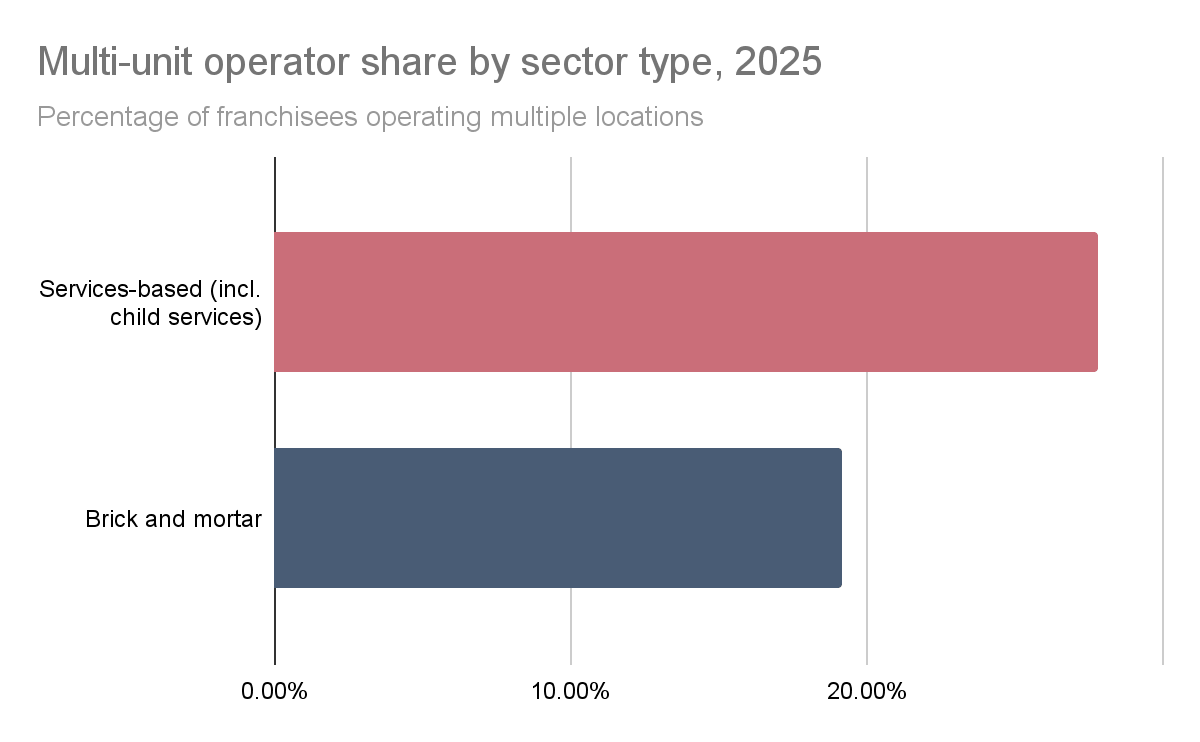
Multi-unit ownership is also growing faster in service-based categories than in brick-and-mortar sectors. The report notes that 27.8% of franchisees in service industries are multi-unit operators, compared to 19.2% in traditional food and retail formats. For investors with the capital and bandwidth to open multiple locations, child services offer a clear path to scale in markets where demand still exceeds supply.
Is an Education Franchise Right for You?
Education franchise profitability in 2026 holds up well against most investment categories. The demand is need-based, the growth numbers are the strongest in franchising, and there is genuine white space still available in underserved markets. The variable, as always, is execution. Staffing quality, site selection, and regulatory readiness determine whether an operator reaches the upper end of the income benchmarks or not.
If you are ready to take the next step, Franchise.com can help you find the right fit. Explore our listings of leading education and child services concepts to compare entry costs, formats, and ownership requirements, or browse hundreds of other categories if education does not fit your profile.
Skip the guesswork. With access to hundreds of vetted brands and over 25+ years of helping entrepreneurs find the right fit, Franchise Ventures is the most efficient way to turn interest into ownership.
Categorized Under: Franchise Information, Franchise Ownership
Other Franchises Looking For Owners Like You
Want to compare franchise opportunities side by side? Start Here
